Community Partnership Program
Mission Statement
The Community Partnership Program (CPP) is designed to deliver long-lasting positive economic, environmental, and social impacts in our local communities. Buffalo Sewer is dedicated to developing an equitable, inclusive, and comprehensive Community Partnership Program to better serve and foster partnerships within our local communities.
Through local partnerships, volunteering, and financial contributions, our goal is to grow a workforce talent pipeline that supports Buffalo Sewer’s core services and ensures City of Buffalo residents experience public benefits, including opportunities for generational wealth creation, workforce/business development, education, and improved environmental health.

Program Eligibility:
FIRMS:
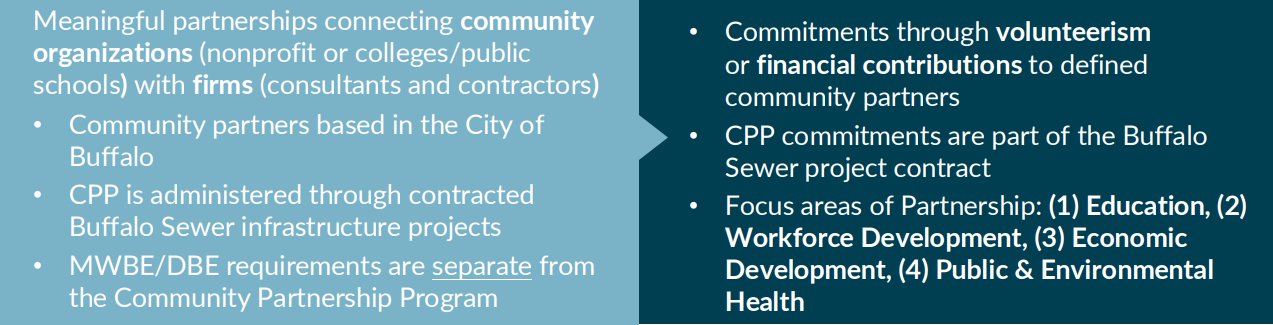
Firms participating in professional services contracts over $500,000 or construction contracts over $2,500,000 must submit a Community Partnership Proposal.
Eligible beneficiaries include 501(c) (3) nonprofits and public schools/ colleges in the city of Buffalo. Contributions must benefit the community and cannot be passed through to subcontractors.
Community Partners:
Ensure your organization is a registered 501(c) (3) nonprofit or public school/ college in the city of Buffalo.
Community Partnership Program Focus Areas:
Education
Supporting educational programs and initiatives, particularly focusing on Science, Technology, Engineering, Arts, and Mathematics (STEAM). These programs aim to equip individuals with the knowledge and skills necessary to excel in these fields. By fostering a strong foundation in STEAM, the program will inspire the next generation of innovators and problem-solvers who can contribute to the community’s growth and sustainability.
Workforce Development
Economic Development
Public and Environmental Health
Improving public health and environmental quality is central to the mission and serves as a key driver for enhancing overall well-being. This program is designed to support both community members and public spaces, fostering their care and development for a sustainable future.
Community Partnership Documents


FAQs
How does the Community Partnership Program Work?
-
– Contractors and consultants are informed about the program during the RFP process.
-
– If their contract exceeds the required threshold, they must submit a Community Partnership Proposal with their bid.
-
– Participation becomes a binding part of the contract, and failure to comply may result in penalties or disqualification.
Who is required to participate?
-
– Professional services contracts over $500,000
-
– Construction services contracts over $2,5000,000
Who can benefit from the program?
-
– Registered nonprofit organizations with 501(c)(3)
-
– Public schools and colleges in the Buffalo Sewer Service Area
What is the Difference between Community Partnership Program and DWMBE Requirements?
- – Community Partnership Program:
- Voluntary initiatives by contractors and consultants to support the local community. These are not legally required but may be
encouraged by project owner. - – DBE/MBE/WBE Requirements:
- Mandatory contracting obligations requiring engagement of certified historically underrepresented business enterprises in
compliance with applicable laws and regulations.